Graymont Cooperative Association
History  06/12/07 2:08:33 PM About us 

HISTORY OF THE GRAYMONT CO-OP 

1903 

During the year of 1903 several farmers in the Graymont vicinity, throughly aroused by the excessive margins assessed by the local grain men for handling their grain, began to discuss a "farmer owned" elevator.  They believed that such an elevator could be successfully operated by considerable less margins than taken by the local independent  elevators.  Farmers in the grain states of Illinois and Iowa were generally expressing theis dissatisfaction against the methods of their local operators.  This helped to create attention to the leaders, since a few points had established Farmers Elevators and a way was shown and help obtained to foster the plan.  Several meetings were held which culminated in the granting of a Charter to the Farmers Elevator Company of Graymont, Illinois on January 2, 1904 by James A. Rose, Secretary of State. 

One of the very first Graymont Co-op Elevator meetings is recorded as being on November 11, 1903.  Henry Brinkman called the meeting to order and stated the reason for the meeting.  Thomas Whalen wa nominated as temporary chairman for this meeting starting an elevator.  A committee of Henry Brinkman, James Frobish, and Wm. Pampel was delegated to look into subscriptions for stock.  It was moved at this meeting that this company be capitalized at 10,000 and they handle grain, coal, and building materials, with shares at $50.00 per share and limit of ten shares of stock per member.  The very first stock certificate - Certificate #1 - was issued to Abe Zimmerman and was dated May 20, 1904. 

On November 4, 1903 the second meeting of the Graymont Co-op came to order.  Three trustees were elected to incorporate as soon as the committee on subscription reported One Hundre Fifty shares sold.  The trustees elected at this meeting were William Pample, William Tuttle, and Henry Brinkman.  James Breen moved that the organization be called "Farmer's Elevator Company of Graymont" and the motion carried. 

1904 

February 15, 1904 the very first seven board members were elected and they were as follows:  John Beller, George L. Potter, Thomas Whalen, Samuel Earp, Henry Brinkman, John Snyder, and Joseph Unzicker. 

February 29, 1904 J.G. Unzicker prepared ballots and the directors proceeded to draw for the length of their term of office, which resulted as follows:   

John Beller, J.F. Snyder, George Potter---one-year term
Henry Brinkman and Joseph Unzicker---two-year term 
Samuel Earp and Thomas Whalen---three-year term 

At this meeting Thomas Whalen, was elected Chairman; George Potter was elected Scretary; and Samuel Earp was elected Treasurer. 

At this meeting a three man committee was appointed to look for a location and get specifications for building an elevator.  The three men appointed wre Joseph Unzicker, Samuel Earp, and John Beller.  George Potter was appointed to put notices in three of the Pontiac weekly newspapers asking for bids and and application for manager of Farmers Elevator of Graymont. 

On March 1, 1904 Joseph H. Unzicker was hired to be the manager of the Farmers Elevator of Graymont for a wage of $50.00 per month.  A vote was taken for the capacity of the elevator which resulted in 40,000 bushel.   

                           Picture at left is
             Joseph H. Unzicker, 
                first manager at
      Farmers Elevator of Graymont.

Being unable to purchase one of the elevators that were already established in Graymont they succeeded on May 7, 1904 in purchasaing a strip a ground from William Pample onthe north side of the Illinois Central railroad tracks for the sum of $300.00 and thereon proceeded with plans to build an elevator.  The size of the lot would be 396 feet by 110 feet. 

The firm of Younglove and Boggess of Mason City, Iowa was given the contract to build an elevator at Graymont, Illinois, to be completed by July 15, 1904.  The cost would be $6,575.00.  The firm of Younglove and Boggess would be given bond for $5,000.00.  The company had expected to begin operations in the late spring but considerable trouble was experienced in getting the Illinois Central Railroad to put in a spur track for the elevator.  On August 22, 1904 the Farmers Elevator Company of Graymont was complete and the first grain was taken in to the new elevator on November 1, 1904.  The cost of the land, new elevator, office, organization costs, and other necessary for the start-up left the sum of $1,683.00 for working capital.  This sum proved inadequate for operating and it became necessary to borrow money almost from the start


First elevator and manager standing outside of office 


On August 19, 1904 Ezra Frobish was employed to work for the Farmers Elevator Company at $40.00 per month.  He would begin work as soon as the track was laid.  The manager was also given instruction to buy one car load of oats and one car load of corn to be delivered as soon as the elevator was completed.  The manager was ordered to buy grain on a 1 3/4 cent margin. 

During the month of November, the opening month, a large quantity of grain was handled and a strong cash demand for all grain existed, consequently the profits during the first few months of business was far above expectations.  The members were indeed jubilant.  The elevator was operating on a small margin, success was assured and the path was open for a real "farmer owned" enterprise. 

The manager, however, had his troubles.  He found the market very limited for his offerings.  John West & Co., Lowell, Holt and Co., and H.H. Freeman were the only firms taking the grain.  The Federal governmant had not yet established the Grain Standards Act, and corn was bought and sold on the basis of No. 3 or better, the grade being established gy the Board of Trade inspectors.  The grain commission firms had no confidence in the farmer elevator movement and all but the few firms listed refused to handle shipments or bid for the grain, which consequently restricted the markets.  Practically all the grain had to be consigned.  This resulted in market risks that need not have been encountered had there been adequate track selling facilities to buyers.   

Probably the most annoying circumstances encountered by the manager was discrimination against his company and this station on the part of the railroad employees in the distibution of cars in times of scarcity in quality, size and number.  The matter of number was soon adjusted and eventually account was kept of tonnage as well. 

Unfair price competition was another condition rather hard to meet satisfactorily-competitors paying track prices or more (from one or two cents mare than they were paying in contiguous territory).  This, however, had its compensating advantages in that it brought much grain from immediately outside the territory and in that end made for more loyal friends than any ither one thing. 

1905 

February 8, 1905 a ballot was taken to decide the value of stock.  This ballot resulted in three votes for $50.00, two votes for $54.00 and one vote for $50.50. 

The very first annual meeting of stockholders of Farmer's Elevator Company of Graymont took place on February 20, 1905.  New board members were elected for a term of three years and were as follows:  George Potter, John Beller and Frank Weber. 

March 2, 1905 the following officers were elected: 

                                   President---Thomas Whalen 
                                   Secretary---George Potter
                                   Treasurer---Samuel Earp 

May 17, 1905 a motion to build a 1000-bushel corncrib to hold ear corn was passed. 

1906 

February 19, 1906-The second annual meting of the Farmer's Elevator Company of Graymont was held at Weber's Hall in Graymont.  James McKay audited the books of the company at a cost of $10.72.  Thomas Whalen was allowed $13.17 for expenses while attending the Farmers Grain Dealers Association Meeting.  A dividend of 6% was given to stockholders.  The new directors nominated were Henry Brinkman and Joseph Unzicker. 

1907 

July 16,1907 a decision was made to build another elevator with a capacity of 40,000 bushel.  The cost would be $6,088.14 plus wages of Goerge Saathoff to be hired to supervise the construction at $4.50 per day and carpenters to be paid $3.00 per day. 


Picture at right
is the second
addition to the
elevator built in
1907.


1908-1912 

On May16, 1908 the Farmers Elevator of Graymont bought the TIle Company, which was owned by S.B. Slyder.  The manager was granted a 2 week vacation. 

In 1909 a 10% dividend was declared. 

September 15, 1910 an automatic scale was bought. 

At the Annual Meeting in 1911 a motion was put forth and caaried that the company store grain at 1/2 cent per bushel per month after 30 days as anecessity and not a desirable thing and the company does not encourage it.


Picture to the left is of a
postcard of A.G. Jacobs,
a horse and wagon bringing
grain into the elevator. 
(Great Grandfather of
Grain Manager, Matt Jacobs.)


December 30, 1912 Joe Eyman was hired as the second manager for the Farmers Elevator of Graymont. The old office was moved and used as storage and a new office was built. Making the grain office 92 years old.   

 
 Pictured at left is Joe Eyman
 hired December 30, 1912.


1913 

January 10,1913 the Farmers Elevator of Graymont was completely destroyed by fire.  The newly hired manager's first duty was to supervise the building of a new elevator.     


January 21, 1913 Mr. George Saathoff made plans to immediately build a new 70,000 bushel house 56 ft. wide and 50 ft. long and between 55 ft. and 58 ft. high with 14 bins.  Cost was estimated to be around $11,000.  

At the annual meeting held on February 17, 1913 the first manager, J.H. Unzicker retired due to failing health. 

May 23, 1913 the new elevator was completed with a cost reported to be $11,842.49.  George Saathoff was given a commission of $470.00 as the builder of the facility.  This made the final cost of the elevator to be $12,312.49.  In the following years the dump pits were made larger, a truck hoist was installed and floor joists were added to accomodate the heavier trucks and the capacity of the elevator legs were increased. 


August 6, 1913 the directors consider more sidetrack and storing of oats. It was passed to secure more tracks.  A motion was made not to store the oats for more than 30 days, at the meeting on September 29, 1913 the cost of the sidetracks being $1,000.00 was too much for what it would be worth. 

September 29, 1913 it was decided to change banking from Pontiac National Bank to State Bank or Graymont. 

1914 

February 16, 1914 - An annual meeting was held.  A profit was made in the amount of $2,697.89 and a dividend of 10% was declared.  There was some discussion on a Nice Road Bill.  Mr. Van Gilder of Chicago spoke on the question of "Hard Roads". 

1916 - 1919 

On February 21, 1916 an outside grain cleaner was installed. 

March 8, 1916 it was decided to proceed to construct a shed and start into the lumber business.  William Pampel agreed to take $350.00 per acre for his land poviding the company bought land to corner of fence.  The railroad also agreed to extend a siding 100 feet West for $150.00. 

On August 22, 1916 William Hooper resigned and Fred Brill was hired. 

November 28, 1916 the land on the South side of the tracks was sold to Henry Brill for $300.00 and the shed to was sold to Joe Good for $280.00.  

In 1917 the Annual Meeting was the first one where a dinner was served.  This was also the year that a suit was filed against a customer for damages on failure to deliver grain sold.   

On February 18, 1918 a net profit of $5,727.10 showed.  It was voted to raise the capital stock to $30,000.00. 

On January 17, 1919 an audit showed a new gain of $12,325.09. 

1920's  

February 16, 1920 a Howe scale was purchased. 

July 19, 1920 a Phosphate bin was built.
October 11, 1920 showed a loss of $8,690.85 from January 1, 1920 to August 24, 1920. 

A special meeting of the stockholders was called on December 7,1920 to vote on a new Corporation Act of the State of Illinois.  A vote was taken and the results were 514 votes for and 22 against the name of the company from Farmers Elevator Company of Graymont to Graymont Cooperative Association.  The capital stock was increased from $30,000.00consisting of 600 shares of the par value of $50,000.00 to $60,000.00 consisting of 600 shares of the par value of $100.00. 

On February 1, 1921 the name was changed to the Graymont Cooperative Association.  In Rebruary 23, 1921 A.B. Sheeler of Chillicothe was hired as the new manager. 

On February 1, 1922 a loss in the amo9unt of $8,877.33 was shown at the annual meeting. 

In minutes of the April 12, 1922 director's meeting the desirability and cost of establishing a radio station was discussed.  It was then approved in the July 14, 1922 meeting that a radio outfit be installed. 

December 10, 1923 it was voted that two truck dumps be purchased and installed.  The total cost being around $800.00 and were installed in 1924. 

February 18, 1925 it was voted on to erect a building big enough to handle the mill products.  George Carl was hired as a third man.  The first company owned truck was gought in 1925 as well as the first electric motor to power the elevator machinery was installed. 

The first soybeans were purchased and the first car load was shipped in 1926.  There was about 1200 bushels and the profit made on that car was $61.27.  The following year the company would handle 3992 bushels of beans.  September of 1926 brought about the purchase of a house for the manager to live in from Joe Eymann for $5,000.00.  

1930's
   

On August 12, 1931 the Rogers Grain Elevator in Graymont was bought in the amount of $1,200.00 for the elevator and property.  Five years later, on October 27, 1936, the railroad propertythat ran along the Rogers Grain Elevator was purchased for a price of $250.00.  The early 30's were tough years because of the depression.  In 1932 the company purchased 713,792 bushels of grain and paid the farmers of the area $176,982.71, for and average price of a little under 25 cents a bushel. 

The cost of the Annual Stockholder's Meeting held in 1935 was $107.84.  As early as 1927 the Board discussed building a feed mill.  At the Annual Meeting in 1930 the was 30 for and 28 against building a mill.  In 1935 the board approved the building of the feed mill. 

Clinton Reedy was hired on November 10, 1936 to work in the elevator until the mill was built. 

1938 

On November 9, 1938 a resolution was made that the Co-op had been approved by the Livingston County and the Woodford County Farm Bureaus to distribute in their counties Blue Seal Feed concentrates and manufactured feeds. 

1939 

At the February 1, 1939 Annual Meeting there was only 187 shares present.  Two hundred thirty-five shares were needed to make a majority.  A motion was called to adjourn the meeting.  This meeting was re-scheduled for February 21, 1939. 

On August 14, 1939 a new sheller and corn cracker was purchased. 

September 13, 1939 a grain dump was purchased to fill bins that are being erected for the sealed corn.  A new corn-testin machine was also purchased with the old one traded in.   

1940

A sack sewing machine was purchased for the Feed Mill on February 16, 1940.  In April of this year a resolution was adopted to purchase any number up to but not to exceed 20 shares of the State Bank of Graymont at the price of $100 per share.  October 9th they purchased a 1 ton mixer for the Feed Mill. 


1941 

Vernell Drager was hired as bookkeeper in June of 1941.  He took the place of Eldon Zimmerman who was drafted.  The first bookkeeping machine was purchased. 

1942 

In 1942 the Hatchery was started and was located in the rear of the Graymont Hardware.  In January of 1942 the board decided to sell baby chicks.  They had orders for 2000.  On February 10 William Mundschenk met with the board to ask them to run the Graymont Hardware Store while he goes to the army.  It was decided that same spring that they allow any of their employees to do home defense work if appointed or called. 

This same year a new coal elevator was purchased as was a hatching unit and the West room in the Hardware Store was rented to set up the hatchery.  A house for pullets was built and Gerdon C. Gundy was hired to run the hatchery. 

1944 

February 19, 1944 John Schaefer was hired to replace Floyd Rich in the Feed Mill.  The board also voted to sell phosphate.  In October of this year the Co-op bought the railroad property between the railroad and mill for $80.00.  At the Annual Meeting of this year it was moved by Glenn Antrim asking permission to offer a resolution for G.L., who has been a board member for Forty years, and because of illness which has caused him to withdraw from any further participation in the affairs of the Association, that they declare him a Life Member of the Board of Diredtors in an Ex-Officio capacity.  This motion was approved.  Max Winters was elected for the new position. 

1945 

In 1945 the Unzicker house was purchased and a new building was built at that location.  The Hatchery stayed in operation until the early 70's . This building is now used for our Soil Lab, which was started in 1958.  This building was also the headquarters for the Fertilizer Department.  A workshop in the rear of this building is used to service equipment. 

It was reported this year a net income of $58,016.37.  That was before deduction income taxes. 

1946 

A hammer mill was purchased in March of 1946.  The mill had a one hundred-horse power hammermill and one vertical mixer of one and one half ton capacity. 

In April of 1946 at the board meeting it was moved to give the Livingston County 4-H Club  a $100 donation to start a park for the use of youth in the county for shows, picnics, camps, judging contests and sports activities.  Today the Co-op spends approximate $2500 a year to support 4-H in Livingston County.   

June of 1946 brought the decision to tear down the Unziker house to make room for the new hatchery building.  This is where the agronomy department is located.  The employees from the Co-op would do the work.  They also made plans at this time to erect a Feed Warehouse approximately 24 ft. wide connecting to the main mill building. 

August of this year brought the addition of two new trucks-one to be equipped with a steel grain box around 300-bushel capacity and having a dump joist.  The other was to have a steel flair box and conveyor for handling soybeans and fertilizer.  A tractor-trailer type truck for hauling grain was also purchased. 

1949 

At the Annual Meeting in 1949, Board Member Henry Carstens, went off after 42 tears of service.  Dale Bateman was elected in his position. 

1950 

In March of 1950 the board moved to purchase a new car puller and accessories, a new unloading conveyor, and also to erect a bulk phosphate plant that would be built by J.L. Wroan & Sons at a price of $9868.00. 

This same year a raw rock phosphate plant was built and the Board approved the purchase of a radio for the office to get the market quotations. 

1951 

Professor L.H. Simerl was the speaker at the annual meeting.  His topic was "Inflation-Farmer's Friend of Foe". 

1953 

1953 brought the pruchase of a 12 foot EZEE-Flo Fertilizer spreader at the cost of $300.00.  They also purchased a cob crusher for the mill. 

1955 

July 20, 1955 it was reported that the board members had discussed building a new elevator addition with hopper bottom in each new bin. 

1956 

In March a 50x100x14 Butler building to hold 67,000 bushel was bought.  This building was to be erected by the Mendota Building service of Mendota, Illinois at a cost of $17,468.  The building was to be erected just West of the Feed Warehouse and to be used to store Government corn.  The storage of CCC corn was a big factor for income for coutry elevators in the 50's.  This building is used today to store feed and related items. 

This year also brought the purchase of a 68-D Clipper Cleaning Mill at the cost of $2,049.61.  A purchase of a Model 6 conyeyer at a cost of $454.  The old Kewanee Car unloading conveyer was also repaired.   

In September the co-op purchased the school lots and building.  It was decided to tear down the building and salvage the lumber.  This work was to be done by the employees in their spare time this winter.  They installed a machine to mix liquid milk with ground feed. 

1957 

January 2, 1957 Vernell Drager was installed a s the new Manager.  The same year the board approved the purchase of a self-unloading auger wagon to handle bulk feed.  They also invested $25,000 in United Grain Company to help finance a terminal elevator on the river.  The purchase of a Butler building to store 110,000 bushel of grain at a cost of $28,500 was purchased.  This building today is being used for storage of packaged chemicals and pseticides.  The first corn dryer-A Lennox with a capacity of 150 bushels per hour was purchased.  In 1964 another dryer would be added.  A 1000 gallon tank storage of gas for the dryer was added.  

1958 

In 1958 the co-op purchased a Richardson Automatic loding out scale for the elevator.  They also authorized a set up of a soil-testing lab in the Hatchery building.  They purchased a portable livestock scale.  A fertilizer Warehouse was built.  A portable weigh buggy was purchased for use at the mill.  The mill office was remodled with new heating system installed along with new countertops and filing cabinets. 

1959 

The purchase of a seedmixer to mix and inoculate seed was bought in 1959 along with a 100,000 bushel Butler building for the storage of grain.  Today this building is still being used to store grain and equipment.  The furnace in the office was replaced.  The platform scale at the office was repaired and repainted.  A bulk storage plant for anhydrous was also installed. 

1960 


In 1960 there were debentures issued for the purpose of financing anhydrous pland and trailers.  A new bookkeeping machine was purchased.  A trophy for 4-H Fair was sponsored and it was decided to buy a steer.  The house the Co-op owned was remodeled.  A pension program was adopted for employees of the association.  Purchased 400 shares of Coastal Chemical Company, stock authorization for the selling of liquid fertilizer. 

1961 

1961 brought the purchase of William Hopper lot which joined the lot owned by the Graymont Co-op at $500.00 plus transfer fees.  A new fertilizer spreader was purchased.  The installation of grain conveying equipment between the elevator and annex as well as a new electrical panel.  February 10, 1961 Victor Theesfield was hired and is still with the company making him the longest employed person with the Co-op with his 43 years of service. 

1962 

In 1962 an additional 2 acres of land directly north of our office was purchased from Mabelle Pampel. 

The board decided to try a proposition given to them by International Chemical Co. - a dealership for their 28% liquid nitrogen solution.  The company would set a tank car on our siding and the solution could be pumped direct to sprayer trucks.  There would be no damage for the association if not all sold.  It would be taken back by the company. 

The board purchased a vacuum cleaning attatchment for the grain-o-vayor to be used in cleaning the dust from the elevator and mill.  A Larson 600 broadcast fretilizer spreader was also purchased at a cost of $905.00. 

1963 

In April of 1963 $20,000 in debentures at a rate of 5% was to finance larger corn drying equipment, a new shop and show room building, and to finance a house being built by Ronald Fairly.  Also hired Jack Phillips of Washburn to scrape, reseal, and apply two coats of paint to the elevator. 

On September 11, 1963 they voted to issue $40,000 in debentures to finance the mill improvements.  The debentures are to carry 5% interest. 

On October 9 Vernell Drager reported that 32,000 bushels of soybeans were stored for customers and he expected to store approximately 40,000 bushels of new corn. 

In November it was discussed the need of a new corn dryer and handling facilities to handle the larger volume of wet corn being delivered during harvest season.  A new manlift was also installed at a cost of $194.97.   

1964 

In April 1964, an inoculator and handling equipment was installed in the mill.  In August a contract was signed with Comprehensive Home Improvement Plan for the Lumber Yard.  In September they purchased a Lennox corn dryer from S. W. Naylor at a cost of $175.00.  In October it was reported that they had purchased a bulk fertilizer spreader for a cost of $1400.00.  They approved an extension of the railway siding to a point West of the Lumber Shed.  This extension to be used for unloading fertilizer. 

1965 

In 1965 they approved buying two used anhydrous ammonia applicators at a cost of $220 each and approved the leasing of four anhydrous trailer tanks from International Mineral Company at a cost of $90.00 per year each.  A contract was signed with Mr. & Mrs. Russell Tesch to erect six to ten one thousand bird laying houses.  The Association is to sell the house and furnish the layers, feed and health program with Mr. Tesch being paid 8 1/3  cents per bird per month.  They had the machinery so start building the Fertilizer Blending Plant.  The cost of this plan is $37,538.49.  Debebntures were being sold to cover cost.  A contract with Faultless Milling Company in which the Co-op and Faultless Milling Company would furnish feeder pigs for local feeders to feed to market weight.  They also purchased 3 new Larson 800 Fertilizer spreaders at a cost of $3640.00.  A contract with Stotler Grain Company to employ their services in a hedging operation. 

1966 

Vernell Drager reported to the board that 42,000 bushel of beans were in storage and 125,000 bushel of corn for customers.  Discussion on building a new elevator was started but nothing would be done until they had the money to start. 

1967 

After considerable discussion a new 350,000 bushel concrete elevator was built by the Mel Jarvis Construction Company in 1967 at a cost of $350,000.00.  Also a 1500 bushel per hour Aeroglide dryer was part of this installation.  This was probably one of the biggest steps this company had taken since the original elevator of 1904. 

On March 30, 1967 a special meeting was held and the board signed a contract with James Burdick of Burdick Aeration Company, Inc. to purchase an aeration and temperature recorder.  The board also met with Gene Bohkle of the Aero Glide Corp. and signed a contract for an aeroglide 2000 bushel per hour grain dryer.  Loren Zimmerman, Electrical Contractor, was hired for the new grain dryer at $2,482.82. 

Two new five row and two new seven row anhydrous applicators were purchased in 1967 for a total cost of $5,191.42. 

The new dial telephone system, due to be installed by Prairie Telephone Company, was discussed and four business phones and one residential phone was to be installed. 

In October Vernell Drager, manager, reported a crop of 45,000 bushels of soybeans and 225,000 corn stored at the elevator. 

1968 

February 9, 1968 a final fayment of $31,050.00 was made to Jarvis Construction Company bringing the total to $327,558.00 for  the new elevator. 

In 1968 the Flanagan Mill was purchased from Alvin Ackerman and on July 1, 1971 this mill would be closed down due of equipment problems that Board felt were too costly to replace. 

1969 

A M&W anhydrous appliocator costing $1,823.92 was purchased.  A fire alarm system was installed in the old elevator and annex at a cost of $662.62.  They purchased two 11 1/2 ton bulk bins for the Flanagan Mill at a cost of $2,005.73. 

1970 

In February of 1970 a bid from Smith Construction on installing an auger in the old elevator and annex at a cost of $1,246.76 was received.  A fertilizer spreader purchased at a cost of $4,100.00.  They also purchased a new bookkeeping machine at a cost of $8,000.00.  A motion to buy Galva Co-op 1967 Hagie 4 wheel model 437 sprayer at $1,350.00.  A special meeting was called to discuss what it might cost to put the Flanagan Mill in good operating condition.  It was decided by the board of directors to close the Flanagan Mill effective July 1,1971. 

1971 

G.C. Gundy submitted his resignation as Manager of the Hatchery in November of 1971.  It was moved then that they phase out the hatchery operation effective on January 1, 1972 and asked Mr. Gundy to help sell out of the hatchery equipment. 

1972 

In February of 1972 it was boted to put a roller mill in the mill.  They made a motion to sell the coal held by the Co-op and discontinue the coal business.   The company had been in the coal business almost from the beginning.  The Flanagan Mill was sold to Flanagan Fertilizer Company for $1,0000.00 in August of 1972. 

1973 

John Wakey was asked to take the Assistant Manager position for the coming year and also have full responsibility of management of the fertilizer department in February of 1974. 

1974 

In July it was agreed to build an additional lumber storage shed.  It was discussed and decided to purchase two Dietrich tool bar applicators and three anhydrous nurse tanks and trailers.  Also a 3/4 ton truck and sprayer was also purchased. 

1975 

March 1975 brought the first lady speaker Pat Leimbach of Vermillion, Ohio, to our Annual Meetings she gave an amusing and interesting talk about her life as a farmers wife.  The cost of this stockholders dinner meeting was approximately $4,000.00 and in comparison the dinner meeting in 1935 was $107.84.  

In May it was voted to screen the dryer in and have an automatic probe system installed to take grain samples.  In August a new Larson Spreader was purchased at a cost of $4,700.00.  It was also approved to have Air-Flo Sandblasting & Painting Company of Campus to paint the dryer. 

1977 

In 1977 four concrete silos were built with a storage capacity of 300,000 bushels.  These were financed by debenture notes up to $380,000 at an interest rate of 7%.  These are the four silos north of the main elevator. 

1978 

A commercial band radio system for the fertilizer trucks was installed at a cost of $1,792.00 from Wheeler Communications of Flanagan. 

The company purchased the Big Wheels to custom spread fertilizer and chemicals on the farmer's fields.  This piece of equipment was the largest single investment in this type of equipment in the history of the company. 

1979 

In 1979 at the Annual Stockholer's meeting, Vernell Drager gave a short summary of the 75 year history of the company and also read a letter from Mr. Aman B. Sheeler, a former manager.  He read a list of former employees who are now deceased.  He also read a list of living, former employees, and asked that those former employees stand and be recognized.  He also gave Mr. Dale Batemen a plaque for his 30 years of service on the board. 

In March of 1979 a new scale was discussed which would replace the old one on the South side of the office.  A new truck for the Lumber Department and a new well to hilp the Fertilizer Department in their spraying operation were part of the new additions for 1979.  A new Ford truck and bulk feed box for the Mill Department was purchased at an approximate cost of $18,000.  It also was approved for the addition of a solution tank for the Fertilizer Department at an approximate cost of $5,000. 

1980 

A new Aeroglide drier which uses natural gas to operate was ordered at a cost of $250,000.  It was also approved to purchase a 18,000 gallon propane gas tnk for the old drier at a cost of $29,375. 

1981 

In 1981 the Machinery Committee met and talked about purchasing six DMI used tanks at a cost of $15,300.  The Co-op purchased a flame photometer, a digital indicator for the old scale at a cost of $3,854.75 and a dormal inoculator for the mill at a cost of $3,200.00  They purchased a Model PC 5500 grain cleaner including a service platform for $898.44.  A letter was read that the ICG railroad would continue service to Graymont until December1st.  In September they approved the company to sell bulk liquid herbicides. 

1982 

At the annual meeting in March of 1982 it was announced that Vernell Drager was retiring as the General Manager effective March 31, 1982 after 41 years of service.  John Wakey was introduced as the next General Manager.  Daryle Harms was named as Fertilizer Manager. 

In May 1982 the railroad property was bought for $41,000.  They also purchased 2850 gallon Stainless Steel bulk tank pump and meter, two Stainless Steel 175 gallon tanks with pumps and meters, four 1000 gallon anhydrous tanks and trailers, and five new DMI anhydrous tanks. 

1983 

A contract with D & L Smith Construction was signed for a Doden Silo 60x136 concrete tank at a cost of $307,552.79.  This silo holds 300,000 bushel of grain.  1983 was a drought year in the corn belt and not one bushel of grain was put into this new silo in its first year.   

At the Annual meeting this year, Martin Duffy retired from the board after 29 years of service. 

In March it was decided to purchase a 1978 Hagie Diesel from Clarion. 

1984 

A direct ship grain policy was approved that being a premium of 2 cents for corn and 4 cents on soybeans for grain pick up on the farm and shipped directly to the terminal. 

1985 

A new computer system was purchased from Robert Grossman.  Also a Terra-Gator was purchased at a cost of $75,274.  In November it was announced that our grain broker had joined E.F. Hutton in Bloomington.  It was approved to maintain their account with E. F. Hutton. 

1986 

It was decided in 1986 that another 300,000 bushel concrete silo was needed for storage.  A contract was signed with Doden Silo Company.  It was also decided in July that with the new silo they would still be short 6000,000 bushel and it was decided to also erect a 120' x240' cleary building with a capacity of 400,000 bushel.  A new 1061 Model vac was purchased to help with the flat storage and a 4020 John Deere tractor to run the vac. A Wrangler loader for the Fertilezer Department was bought at a cost of $20,034.00. 

1987 

In January 1987 they adopted a policy of no patronage being paid on direct ship grain from the farm and raising the premiums paid on grain picked up from 2 cents to 3 cents per bushel on corn from 4 cents to 6 cents per bushel on beans. 

1988 

May of 1988 the Rooks Creek Board has asked their Manager, Dwane Ahrends, to contact us about merging the operation.  It was reported that the Co-op has committed to take over Meadow's Co-op Feed business beginning June 1st.  The extra probe for the grain office was purchased for a cost of $7,010. 

1989 

Leatrice Mitchell retired on February 16, after 34 years. 

1990 

On April 6th a special board meeting was held in the office of the Co-op to discuss merger talks with Rooks Creek Farmers Elevator.  On April 26, 1990 a joint committee meeting was held with Rooks Creek Elevator Board and it was decided that each elevator would have to retain their own lawyers.  The new name of the elevator would be Graymont Coperative Association, Rooks Creek Division.The office in Rooks Creek will stay open.  The board structure would be seven men, with the nominating committee selecting according to trade area. 

1991 

On January 21, 1991 the manager reported a 1976 Ford Lift truck had been purchased at a cost of $10,600.  Also a request from Daryle Harms, Fertilizer Manager was to purchase ten-DMI 30" row width trailers for anhydrous tanks at a cost of $14,500. 

On March 2, 1991 the 87th Annual Stockholders meeting was held with approximately 380 shockholders and guests present.  Nominations were placed for the following - Burdell Roeschley, James Carroll, James garretson, Eddie Hoerner, Patrick Duffy, James Duffy and Gerald Bressner.  These seven men were elected with a unanimous vote for a one year term of office.  Two of these men were from the Rooks Creek board-James Duffy and Gerald Bressner.   

On May 14, 1991 a new hyster was approved at a cost of $18,445.  John Wakey reported that repairs and safety rails were done at Rooks Creek at the cost of $14,138.41. 

June 1, 1991 the board hired a Farmland Livestock Production Specealist.  The salary for this specialist would be paid partially by the Co-op and Farmland would pay the other half.  Howard Ferguson will work for the Co-op area two days a week.  On July 9, 1991 Pat Duffy resigned from the board. 

August 13, 1991 a proposal for the sale of the Cornell and Rowe Grain Elevators by Jacobson Grain was discussed.  It was felt that Rowe Grain Elevator was not efficient, badly in need of a great deal of repair, and a lot of farmer owned storage was in the territory.  Cornell hasn't any grain dryer and it has been reported that the town will not give permission to install a dryer,  so all wet grain would have to be trucked out.  The two stations have a total storage capacity of 662,000 bushel.  With an asking price of $460,000.  After a discussion, the board felt there was no interest in purchasing these grain elevators. 

September 10, 1991 Mike Follmer, had been contacted to fill the vacancy as a Director the board and he ahas consented to serve. 

It was reported in October 8, 1991 that Farmland Industries will be closing the Lincoln Mill the end of 1991 because it has been operating at only 60% of capacity and has a costly operation.  It was then approved for Graymont to start manufacture Hog 40 that would keep the Co-o- very price competitive. 

1992 

In February 1992 Haney Communication was to install a VHF radio antenna on top of the Elevator at a cost of $3,783.90. 

On April 14, 1992 the Feed Manager, Dwain Mosier, gave notice that he would be retiring. 

On July 14, 1992 with the better crop pospects for fall, a grain probe was discussed for Rooks Creek, the motion carried. 

On October 13, 1992 plans were made to build a shed for washing floaters of the loading of chemical and 28% nitrogen.  Additional property would be needed to build the new building.  James Carroll, owner of the old railroad property needed for the building, would be willing to sell the land for $5,000 an acre.  After reviewing building plans and discussion,  Mike Follmer made a motion to purchase the railroad property from James Carroll to construct the new proposed building when plans were approved by the State and to drill a well to supply water for spraying.  

1993 

On February 9, 1993 the manager reported that two bulk bins on the North side of the Feed Mill were getting pretty thin on bottom cones and the unloading auger needed to be replaced.  Bids on two different size replacement bins were presented and discussed.  A motion to purchase two  -  24 ton hopper bottom bins, complete with augers for $5,326.00 plus $175.00 for freight and erection.  Bids were also passed out for a new fertilizer nurse truck,  a purchase of a 1993-I H Model 4700 360 diesel from J. Merle Jones & Sons of Normal for $29,431.25, plus a PTO Gear box for $350.00. 

Bids were given out from D & L Smith to erect a 175' grain leg, dump pit and spouting to fill the four North silos and four main house bins at a cost of $114,253.25.  Also included was a bid to run a 12" pipe from the conveyor on top of the West silo to the Cleary building for filling with grain from that point two-12" augers would be mounted to drag the grain West to the other end of the building at a cost of $27,532.50.  Another bid from Smiths  was to demolish the old wood elevatorm, haul to a hole dug on GCA property, and burn and bury what was left.  This bid would not include digging foundation and concrete, but would fill basement with railroad fill and level for $14,000.  Kelly Electric, Inc. proposal for wiring of the pit and leg was $7,645.00 and wiring for the Cleary building was $3,982.00.  Motion made to accept all bids. 

May 11,1993 a meeting was held and it was reported that all the concrete work was completed on the grain pit for the new addition.  The new Market screen, called "Market Plus" has been installed at Graymont and two new bulk feed bins have heen installed at the Feed Mill and are in operation.  The Rinse Shed, for washing floaters and loading of chemicals, is completed and is working out very well. 

In July of 1993 Alan Zehr was talked to about taking the General Manager position upon John Wakey's anticipated retirement. 

A suggestion for the company to furnish shirts for employees was presented to the board.  After a discussion, the following policy was adopted.  It will be mandatory that all employees will have $100.00 credit in their name each year for their shirt purchases.  Style and color of a shirts is not important but they must have the Co-op logo on all shirts. 

1994 

June 8, 1994, eight DMI anhydrous trailers were purchased for 30" rows at a cost of $10,948.00.   

In May of 1994, there was a job opening due to the untimely death of John Wakey, Alan Zehr was named General Manager and Matt Jacobs was asked to fill the position of Assistant Manager.  It was reported that the basement and footings for the new Feed Mill were under way.  Also a search for a new fertilizer manager was underway dude to the accidental death of Daryle Harms. 

It was also reported that $562,000 in debentures had been committed towards the new Feed Mill. 

1995 

In July of 1995 a report ws passed out to Board Members showing a breakdown of the first six months of 1994-1995 and showed the major changes affected by being in a new feed facility.  The report showed that expenses had raised at  least $80,000 for the first six months; the total income had also incresed by $50,000.  In August, Matt Musselman, Farmland's Illinois Sales Manager, was introduced to the board.  Mr. Musselman noted that the Feed Department had made significant strides so far and felt with the present labor situation the mill could handle more volume without increasing labor costs.  In discussing the prospect of an addintion of a Pellet Mill, the board felt it could continue to be looked at, depending on the profitability of the present mill and depending how the livestock industry is perceiving the use of pellets. 

It was peprted that Skyworks. of Gibson City, had completed the painting at the Rooks Creek facility and were paid the full amount of their estimate.  Graymont employees were also in the process of painting different buildings around the company.   

The purchase of the Raymond Carsten property was finalized and the Deed is in the office of Caughey, Legner and Freehill. 

It was reported that the Board voted to hae the old Feed Mill demolished and discontinue the bean cleaning operation as it is now handled. 

In November 1995 a pole shed was constructed for the Lumber Department for approximately $5,041 estimate.  The shed  has a concrete floor, which was not included in the estimate. 

1996 

The Equipment Committee reported that the committee purchased two used 17 knife DMI toolbars with monitors for $11,800.  In January 1996 it was motioned to purchase a Air Ride sprayer from Richland sales for $80,468. 

February a final proposal for constructing a pellet Mill was handed out.  The proposal from D & L Smith Construction Co. was for $395,527.60.  The motion carried. 

March 20,1996 a special meeting was held at the office with Assistant Manager,  Matt Jacobs to discuss implementing  a high oil corn program in the company.  It was mentioned that high oil corn could add value to feed, but reduce feed cost and still could have room for a remium to be paid to the corn producer.  A feed trial by the Feed Department was felt to be the best way to find out if this is true.  It was felt the Mr. Jacobs contract enough acres with producers to produce 20,000 bushel of high oil corn to be stored on farm and hauled to the Co-op as neede. 

A bid of $32,460 was accepted by the board from D & L Smith Co. for installation of a bulk scale load out system for the Feed Mill.  It includes a load cell, digital read-out, printer, hopper, beams and a track.  A well had been drilled to a depth of 160' and producing approximately 5 gallons of water per minute. 

On September 10, 1996 a tour of the pelleting addition to the Feed Mill by Feed Department Manager Kurt Albertson was given. 

In October 1996 it was brought to the attention of the board that Flanagan Farmers Elevator was interested in having a study done on merging with Graymont.  Also one would be done with Prarie Central Cooperative. 

On December 10, 1996 the board informed that the Mazon Farmers would soon be sicontinuing their Feed Department and Graymont Co-op would be handling their major feed acconts direct. 

1997 

In February 1997 a motion was made to accept the bid from Walz Equipment to overhaul the scale on the North side of the Main office.  It was also announced that Board Member, James Carroll would not be seeking another term on the board.  Jim has been on the board for 33 years.  Don Raber would replace Jim Carroll on the board. 

Construction began on the first display house that the company would sell.  This house was located in Flanagan, Illinois. 

A new leg and dryer were installed at the Rooks Creek elevator facility. 

1998 

This year brought the retirement of Jim Duffy from the board after 18 years of service on the Graymont and Rooks Creek Farmers board.  Jim was replaced by his son Steve Duffy. 

This year also brought the purchase of a 1998 18 ton Freightliner feed truck and re re-roofing of the concrete elevator and north silos. 

Graymont Co-op obtained its e-mail address if graycoop@fcg.net 

A 10" x 70' swing away auger was purchased and the hopper in the dry fertilizer shed was replaced. 

1999 

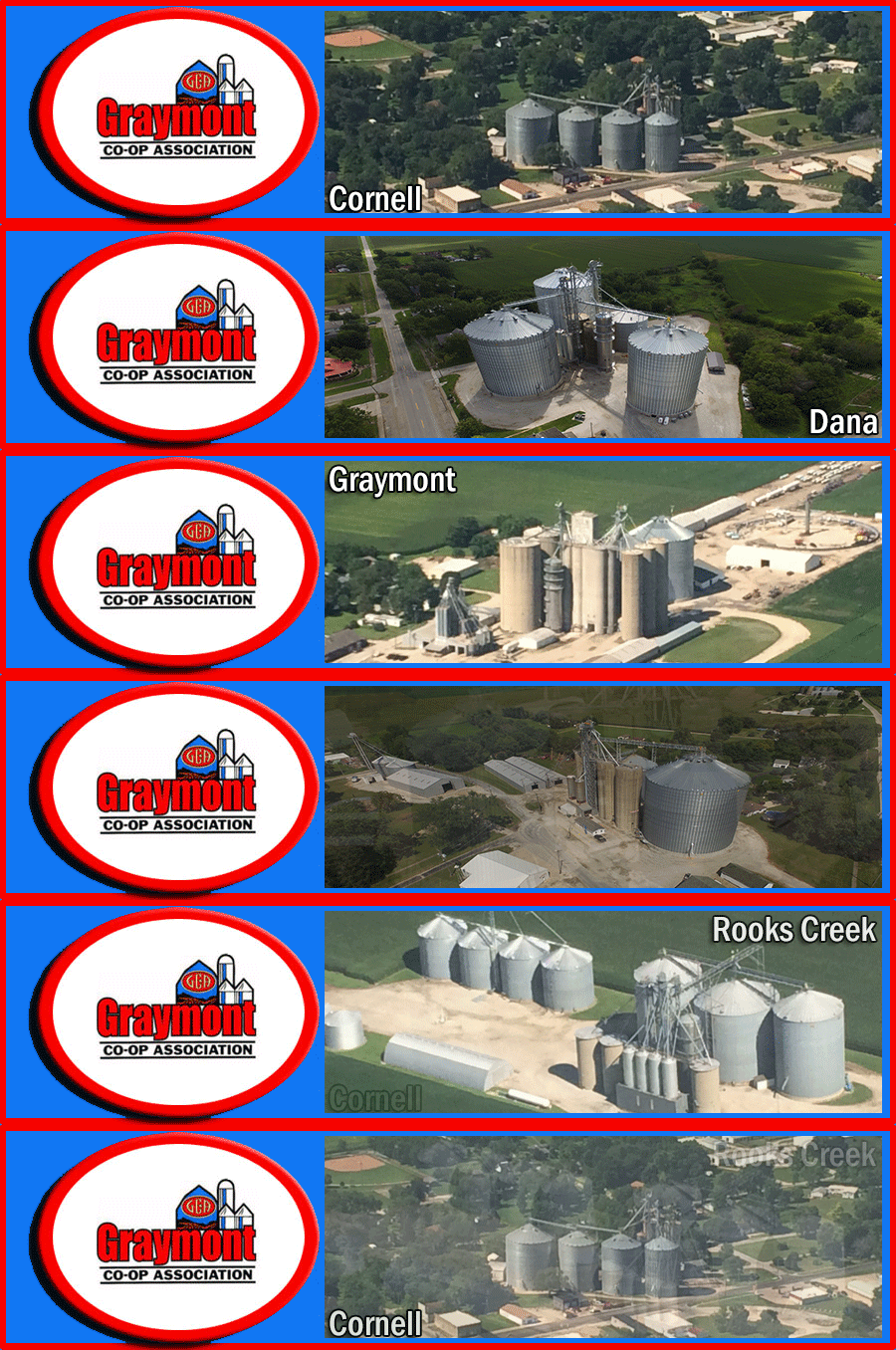
Burdell Roeschley retired from the board after 31 years of service and was replaced by Mark Leach.  Jacobson Facility at Cornell was purchased and that facility was upgraded with a 6000 bushel per hour leg and 3500 bushel per hour GSI dryer. 

A second display house was constructed in Flanagan. 

2000 

An Air Max 2000 equipped with a dry fertilizer unit and an 1800 gallon liquid unit was purchased and purchased a 1995 Freightliner truck and feed body.  And a 1995 Kenworth truck for the Feed Department.   

2001 

Gerald Bressner retired in 2001 after 21 years of combined service with Graymont Co-op and Rooks Creek Farmers Grain.  Gerald, was replaced by Tom Kelly. 

A 315,000 bushel bin was constructed at Cornell facility.  The overhead bin system and new leg were constructed and the old elevator and feed mill at Cornell was demolished.  The old railroad property in Cornell was purchased.  The first 1500 gallon anhydrous nurse tanks were purchased.  Construction of the first display house in the Pontiac community was accomplished. 

2002 

This was the year that our local Co-op got into the insurance business.  The insurance business in Graymont, which was handled by Donna VanWeelden, was purchased and the company started handling insurance under GCA Insurance Services. 

A Grain weigh wagon was purchased. 

A second 315,000-bushel corn bin was constructed at the Cornell Facility.  The Mill roof was re-opened and four additional 1500-gallon NH3 nurse tanks were purchased. 

Farmland Industries filed for bankruptcy. 

2003 

James Garretson retired from the board after 25 years of service to the company and was replaced by Carol Duffy - the first woman to ever be appointed or elected to the board. 

In 1990 Case 721 end loader for lime application was purchased.  Also purchased in 2003 was a micro feed batcher and computer system for the Feed Mill. 

In 2003 the mill mixed 50,000 ton of feed and used over 1,000,000 bushel of corn. 

2004 

A tractor-trailer semi was purchased to transport grain to the terminal market. 

A separate driveway for incoming feed products was constructed in 2004 at the Feed Mill to expedite outgoing feed deliveries.  The Lumber Department started construction on the company's seventh display house.  This house was built in the Illini sub-division in Pontiac.  The grain office and scale is being remodeled to accommodate the larger wagons and trucks. 


Copyright DTN. All rights reserved. Disclaimer.
Powered By DTN